One of the serious challenges in the Bulgarian public sphere is the lack of a dialogue between politicians, on the one hand, and between politicians and experts, on the other. A problem that affects the adoption of policies and actions towards the positive development of our country. The challenges that Bulgaria faces in taking decisive and real action in response to one of the most serious crises today - the climate crisis - are also linked to this problem.
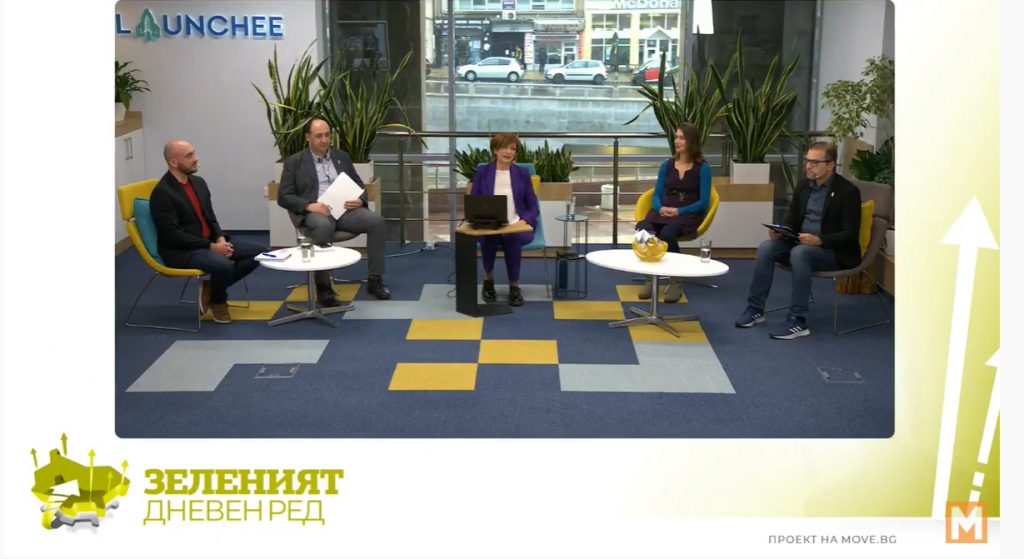
In the spirit of seeking a constructive dialogue and providing a platform for valuable conversations, MOVE.BG has organized a new roundtable where politicians and experts sought together solutions on how to support Bulgaria's sustainable development. The discussion "The Green Public Agenda in Bulgaria: Holistic or Fragmented?" took place a few days before the parliamentary elections and was conducted in a partnership with the members of the MOVE.BG initiated civil society coalition “Green Restart" - WWF Bulgaria, “Greenpeace”-Bulgaria, and the “Institute for Circular Economy”.
The conversation is a continuation of the Coalition's initiative to create a special structure in the new Bulgarian government to manage sustainable development - a Deputy Prime Minister for Climate Transition and Green Transformation. The roundtable brought together politicians from the country's six leading parties, as well as experts from the four organizations in the Green Restart Coalition.
Sasha Bezuhanova, founder of MOVE.BG and moderator of the discussion stressed the need for a change of narrative in the public debate - namely that we need to talk about climate transition and green transformation in terms of the prospects and opportunities for our country's development and economic and societal prosperity.
"We should shift the perspective in the climate transition debate.
We need to look like a country at the opportunities for prosperity and new green jobs that solutions to the crisis provide. Prioritize green energy, science, and economics with the motivation to contribute to global experiences and solutions. To work to conserve our natural resources as a source of health and capital with increasingly significant future value," said Sasha Bezuhanova, who initiated the Green Restart Coalition, adding:
"Climate policies today are much more than regulations on ecology and agriculture. They are becoming horizontal norms in every policy and underpin credit risk assessments of banks and investment markets, the development of cities, and guarantee the long-term sustainability of businesses.
Only with holistic, systemic management of the climate transition, it is possible to make our country competitive in the world's line of development and ensure quality and promising life for the people here."
Having already presented a summary of the politicians' positions in our previous article, we will now introduce you to the experts' point of view. They outlined the connections between climate and energy transition, economic development, and biodiversity - links that are neglected in Bulgaria and that need to be coordinated by a single governance structure such as the Deputy Prime Minister for Climate Transition and Green Transformation.
Climate and energy transition
Apostol Dyankov from WWF Bulgaria stressed the importance of addressing the energy transition for tackling the overall climate crisis. He pointed out that since the last Green Restart Coalition Roundtable, which took place before the snap parliamentary elections in July, there have been several important developments
"First of all, we understood that we cannot continue with coal - the European Commission made it clear to our authorities. Secondly, virtually all developed countries have now set decarbonization and net zero emissions targets - that is, we are all going down that path. The third thing is that there is now a consensus that energy is the first thing we need to change - with the proviso that energy also includes transport, some emissions from agriculture, and many of our emissions from industry. So the long horizon for us is that rather than talking about some phase-out coal date, we need to know how we are going to achieve that decarbonization - whether it is through technological innovation, through working with business and industry. Or whether it will be through social innovation - changes in the way our society works."

Apostol Dyankov.
Denitsa Petrova from “Greenpeace”-Bulgaria stressed several of the important short-term goals for the new parliament, which is to be constructed after the elections on November 14.
"Bulgaria had to transpose the European Renewable Energy Directive this year. This is the other side of the coin - if we close coal-fired power plants, we need to develop renewables. That is why implementing the directive in our legislation must be one of the first tasks of the new National Assembly. The texts of the European directive must not simply be voted through but must be adapted to our reality.
Another challenge is the development of the concept of energy communities - in Bulgaria, it is still theoretical whereas in Europe there are over 2 000 energy communities with over 1 million people united in these cooperatives and forms of association. People are directly involved in the energy transformation. So a regulation that facilitates the creation of energy communities would help in this journey towards energy transformation."

Denitza Petrova.
Climate and economics
Svetoslav Stoykov from the “Institute for Circular Economy” pointed out the fact that the energy sector for a number of reasons is at the center of the debate on the climate transition in Bulgaria, but this does not mean that we should ignore the other sectors affected.
"Bulgaria needs a comprehensive and holistic approach because even if we switch entirely to renewables today, we will still exceed the 1.5-degree warming target. 45% of all global greenhouse gas emissions are generated by the production and use of products, services, and food. We, therefore, need to look more holistically and across sectors.
We need to put three emphases alongside the energy transition. First, to eliminate waste. Secondly, to achieve circularity of materials, products, and services. Third, regenerating natural ecosystems. We need to work across all these systems simultaneously. We also need to work on policies to incentivize product design so as to keep them in 'circulation' for as long as possible at the highest possible level.
It's also important that we emphasize economic incentives and regulatory requirements, as well as educating the administration and training the staff to make this transition."

Svetoslav Stoykov.
Sasha Bezuhanova, initiator of the open network for digital development in Bulgaria EDIT (Economic Development via Innovation and Technology), outlined the main global economic trends and emphasized the fact that the introduction of digital and climate standards simultaneously is a key component for sustainable development and success of the economy in Bulgaria.
"We are seeing the use of digital technologies for climate purposes - for example, to develop renewables and reuse natural resources in the industry, introducing intelligent data processing systems, and measuring carbon footprint in every aspect of production across enterprises and supply chains, recognizing the potential of artificial intelligence to save energy. Also, telecommunication and energy systems are converging and therefore, policies ensuring the energy and digital transition must be developed together.
Data and its processing with artificial intelligence will be one of the most powerful drivers of the economy in the future. The countries that set and prioritize the environment for the development of this type of economy will set the agenda for tomorrow's world.
Where is Bulgaria today?
Our economy is the unenviable 49th most competitive in the world, we are 3.5 times more resource-intensive, and we are among the "modest innovators" in Europe. I mention these figures not to make us feel bad, but because Bulgarian entrepreneurs and start-ups are working today on these big trends I have outlined. So we need to make sure that together they grow up and become a structural determinant for the Bulgarian economy because many of them are leaving Bulgaria after their market tests and that is a collective loss for our country."

Sasha Bezuhanova.
Climate and biodiversity
According to Georgi Stefanov from WWF Bulgaria, overcoming climate change and halting biodiversity loss are two of the most pressing challenges of our time. Unfortunately, according to the expert, while there is recognition of the link between these two topics in scientific circles, most often in policy debates and legislative work, they are not seen as interconnected.
"In practice, in our country, they are largely addressed in their own spheres of action and most often the two policies are considered separately," said Georgi Stefanov and gave a context for the important processes in the world to which we should pay important attention, because Bulgaria, as one of the global leaders in biodiversity, has a lot to contribute:
"This year is crucial because of the global green recovery, on the one hand, and on the other - because we need to take into account what the losses to biodiversity have been over the last decade and we need to set, even more importantly, the targets for the next ten years. To a large extent, climate and biodiversity conventions and agreements are voluntary - that is to say, politicians must take proactive action to implement them.
In the area of biodiversity, halting species loss and recognizing the link between climate and biodiversity are key. Forests and oceans are the most natural solution for absorbing emissions and helping humanity towards a sustainable future.
There is also good news, and this is that increasingly, and at a higher level, both business and politicians are committing to addressing these challenges and to linking the two themes of climate and biodiversity. Unfortunately, this is still not happening in our country and we need to change this, including by creating the role of Deputy Prime Minister for Climate Transition and Green Transformation."

Georgi Stefanov.
Do politicians support the creation of a Climate Deputy Prime Minister - find out in our summary article here (in English). And from the full Roundtable recording, you can find out the positions of politicians and experts on the four rounds of our debate - link to the video here (in Bulgarian). Read our Open Letter here (in English).