The recommendations are summarized in the MOVE.BG report “The Prosperity Compass: Focus Industry” and have been developed using a specialized methodology for long-term and systematic policy-making—strategic foresight analysis.
The answer to this question is provided by the specialized strategic foresight methodology that MOVE.BG implemented several months ago, focusing on the important topic of how to improve the competitiveness of the Bulgarian industry. On June 10, MOVE.BG sent a report summarizing the results of the strategic foresight to the new government and to the new members of parliament. The methodology was implemented by a cross-disciplinary group of 22 leading Bulgarian experts.
“Future” is among the words that we often use and their meaning is well-known: it is the time coming after the present moment. Therefore, we use the word “future” frequently to project the future we want, the way tomorrow would look like.
However, do we really know what we want for our society of tomorrow?
Let us consider the meaning of “future” in socio-political terms:
- A blueprint prepared in advance by “the two great powers” according to which Bulgaria can do nothing, while Europe is powerless and weak and should acquiesce;
- The age-old dream of “Switzerland in the Balkans” with well-preserved nature and prosperous society, which we cherish but leave to the next generation to fulfil;
- Scary unknown that we prefer to tackle “when the time comes”.
In all these three options, we cannot think in terms of what future we want, right? We are just procrastinating bystanders who will not seek solutions to the existing challenges.
“Destined success in life” is another meaning of the word “future” according to the Dictionary of the Bulgarian Language of the Bulgarian Academy of Sciences.
To succeed as a society, we need to know what we want to achieve in socio-political and economic terms and what drivers would be at play in the process of attaining our objective.
We need to decide whether we want to live in a society where:
- Every individual can unleash their potential;
- Business can develop free of dependencies and corrupt practices;
- Industry is innovative and competitive;
- Jobs are secure and well-paid;
- Civil society exercises oversight of the actions of policymakers;
- Politicians listen to the recommendations given by experts in the civil society sector and academia;
- Cities and rural areas are places of prosperity and happy living;
- Polluted air is bygone and there are abundant parks and playgrounds;
- Forests are restored and conserved;
- Rivers are clean and protected;
- Biodiversity is restored.
A possible way to attain this future is to ensure economic freedom and environment for economic development that accommodates people, nature, and society at large. We, MOVE.BG, know that economic freedom underlies any other freedom.
Therefore, we launched this initiative to focus on industry as the main pillar of the economy, and to identify solutions for its development within the global trends of competitiveness: introducing digital and green technologies to upgrade quality and to conserve nature; introducing circular production models and achieving net zero emissions; improving energy efficiency to reduce costs and to decarbonise; implementing innovation to find new markets and to provide more secure and better-paid jobs.
Bulgaria’s industries can develop free of pressure, dependencies and corrupt schemes; they can conserve nature and its resources in the country, ensuring smart and circular use of waste turned into resources to provide for economic resilience and development; they can create secure and well-paid jobs, and develop and implement innovative solutions to improve production processes…
The European Green Deal with its legislative reforms and investment programmes gives us a chance that we must not miss. Notwithstanding some delays and readjustments of some objectives of the Green Deal and in spite of the abandonment of climate policies by the USA, “the leading great power”, the green transition continues to be Europe’s main development programme for 2050.
The green transformation is directly linked to safeguarding democratic development and economic prosperity.
It is only a free society of active citizens that requires and monitors the implementation of nature conservation measures because it knows that this is the way to live better. It is not by chance that many protests against authoritarian regimes, including those in Bulgaria, start with environmental causes. Non-democratic regimes do not care about nature because they do not care about the prosperity of citizens at all. Not accidentally, the growing propaganda against democracy and the European Union goes hand in hand with large-scale disinformation against climate policies and green development.
On the other hand, it is only through greening of the economy that we can guarantee its development today and tomorrow against the backdrop of diminishing resources and ever stronger manifestations of climate change.
For this reason, it is important to make the first step of reforming industry as the main pillar of the economy towards environmental sustainability. It is time to consider what measures will green the economy and how they can be implemented immediately.
Why is Industry an important topic?
Industry manufactures goods which are indispensable or the lack of which would make our lives very difficult: the food, beverages and medicine we consume; the furniture and appliances we use at home; the vehicles, trams and airplanes we use to move; the electricity and heating we use every day; the phones and laptops without which we could hardly imagine our everyday life. And, of course, digital products which roll out in all spheres of life and could help modernise the economy.
We cannot live without industry. Therefore, we should ask ourselves what kind of industry we want to have in Bulgaria. Do we put up with the fact that we rank alarmingly low in terms of competitiveness, which implies insecure jobs, low wages, lack of opportunities for prosperity, and the highest growth rates of production costs?…
The root causes of the problems with competitiveness include the following:
- We use the biggest amount of resources in the most inefficient way to manufacture industrial products. Bulgaria has the most resource-intensive economy in the European Union and that greatly reduces its competitiveness because we use much more resources than other economies in Europe. As well as having problems with its competitiveness, the unreformed industry in Bulgaria exerts unsupportable pressure on nature, on the environment in which we live;
- We use the greatest quantity of energy to manufacture industrial products, The Bulgarian economy is 3.5 times more energy-intensive than the EU average, which means 3.5 times less competitive goods. Huge resources are spent to cover energy costs instead of increasing wages, improving products and finding new markets. The inefficient use of energy is among the reasons for the Bulgarian economy to continue to be first in terms of carbon intensity in the EU;
- We are unprepared for the manifestations of climate change – national and local government authorities, managers and workers are not prepared to respond to floods, heat waves, wildfires or drought so as to save human lives, to safeguard production processes and to protect products and infrastructure;
- We underuse digital technologies and their capabilities of improving production processes and implementing business strategies for development and environmental sustainability – Bulgaria continues to rank second to last in the digitalisation of businesses and society.
Still, there is some good news that could help us overcome all these challenges.
Over 40% of green startups, civil society initiatives and research projects create innovations that are unique in the world. This is corroborated by the data of the second national survey of green initiatives Green Solutions from Bulgaria, which MOVE.BG conducted in 2025.
Green innovators offer solutions in some major spheres of sustainable development, such as fighting climate change, developing the circular economy and protecting natural resources.
Another very important fact is that the high percentage of innovation is sustained in comparison to the first national survey held in 2024. This comes to show that, regardless of all difficulties, Bulgarian innovators continue to contribute to the important objective of ensuring Bulgaria’s prosperity by facilitating its transition to a future with net zero emissions by 2050.
The European Union has set the target of having built a society and economy with net zero emissions by 2050, i.e. to generate as many harmful emissions as nature can absorb.
This is the new competitiveness – simultaneous greening and digitalisation of the economy, while safeguarding jobs. Innovation is the means to facilitate the process.
It is not by chance that one of the seven priorities of the European Commission for the period 2024-2027 is the new plan for Europe’s sustainable prosperity and competitiveness, in which the shift of industry to net zero emissions plays a major role and innovation is the main tool to achieve this target, where 4 billion euro are allocated for its development and uptake.
Many European countries have embarked confidently on this path to guarantee the competitiveness of their industries and jobs. It is time for Bulgaria to follow suit.
To turn this into reality, we must be prepared for what could happen in 2050.
So, let us think together:
- Do we know the factors that could have an impact on the world, on the EU, and on Bulgaria in 2050?
- How could we understand which these factors are?
- What would we do if we knew the possible scenarios for the development of the future?
We tried to answer all these questions with the help of the special strategic foresight methodology and 22 Bulgarian experts from different spheres.
Why strategic foresight analysis?
Strategic foresight is the main tool to prepare for the future, given the interplay of intricate processes that even seem unrelated at first glance, e.g. climate change, digital transformation, outbreaks of viruses, social divisions …
The foresight methodology overcomes the constraints of the conventional linear policy planning (one problem - one solution) and it is used by a number of international institutions and organisations, including the European Commission and the Organisation for Economic Co-operation and Development (OECD).
What did we do?
We, MOVE.BG, together with our partners from SCION Society, organised a special forum of a cross-disciplinary group consisting of 22 prominent Bulgarian experts to analyse what could happen in 2050 and what actions could be taken to prepare and secure the competitiveness of Bulgarian industries by implementing greening measures. Representatives of political parties and local government authorities, businesses, the financial sector, academia and civil society organisations took part in the forum.
The methodology included three main steps. First, together with the experts, we discussed the leading factors/trends that would have an impact on the world, on Europe and on Bulgaria in 2050. After a thorough discussion and putting possible options to the vote, climate change and labour structure were selected to be the two major trends. The second step was to work out four possible scenarios for 2050, depending on the different level of manifestation of these two drivers: from overwhelming climate change to climate change under control, and from a well-developed labour market structure supportive to industrial and green development to severe problems with the labour market and automation. The experts were divided into four breakout groups to work on each scenario and analyse what would happen to society in that case. The four groups were as follows:
- Scenario A: Severe manifestations of climate change, serious challenges to the labour market structure
- Scenario B: Climate change under control, serious challenges to the labour market structure
- Scenario C: Severe manifestations of climate change, well-developed labour market structure
- Scenario D: Climate change, well-developed labour market structure
Finally, we proposed recommendations to reform industry so as to make sure that it will embark on the green transformation path today, to provide for circular and competitive industries which develop free of pressure and dependencies in 2050, to create well-paid jobs, and to protect the environment and ecosystems.
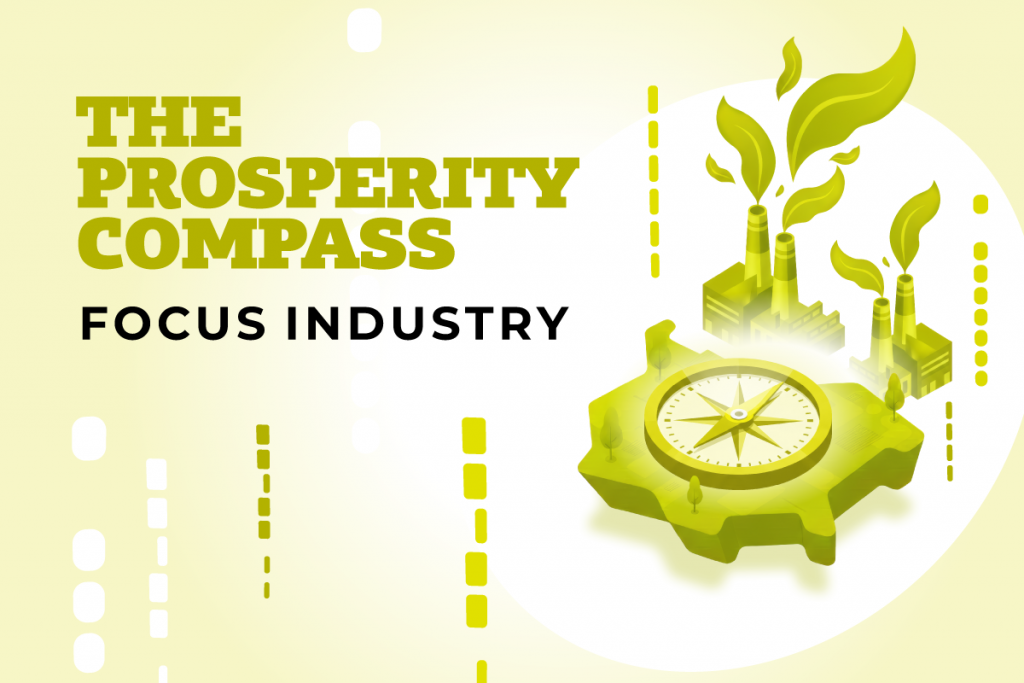
The ideas of the experts are presented in this brochure The Prosperity Compass: Focus Industry.
The four scenarios could be used to plan policies in any sphere because climate change and the labour market structure are and will continue to be major drivers of social development since they impact every social sphere from the development of political programmes and business strategies through the implementation of national and municipal policies to the occurrence of potential triggers of social divisions, social insecurity, and political and economic volatility.
The measures to support the reform of Bulgarian industries, which we developed on the basis of the different scenarios, set out the general guidelines for improving the environment with a view to creating the necessary conditions for the development of industry and safeguarding its competitiveness today and tomorrow.
Competitiveness has new dimensions: high level of digital development and environmental/green sustainability.
Bulgaria stands a chance to be among Europe’s leaders in these dimensions of competitiveness because the innovation developed here provides global green and digital solutions.
It is time to unleash its potential that will facilitate our way to social prosperity.
We believe that this initiative is an important first step in this direction.
See the full report in English here.