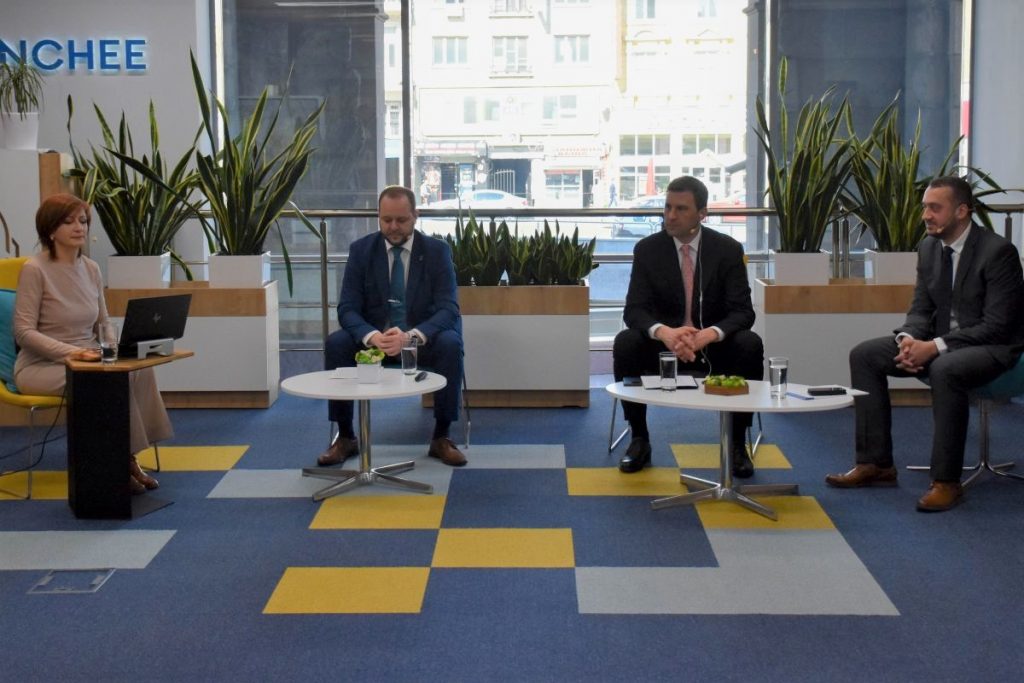
The green transformation is an opportunity to ensure the positive development of Bulgaria and the European Union that we should not miss. This has been shared by leading politicians and experts from Bulgaria and Europe, who participated in the special conference "The Green Agenda: Zero Net Emissions as a Path to a Sustainable Future". The initiative, which took place on April 5 in Sofia, was organized by the MOVE.BG initiated coalition of civil society organizations “Green Restart" in partnership with the Representation of the European Commission in Bulgaria.
Guests at the forum, including representatives of the Commission, the European Parliament, the Bulgarian government, and experts from international organizations, shared their ideas and recommendations for turning the fight against climate change into a chance for economic development, social prosperity, and preservation of our common home Earth. The conference was attended by more than 15 participants, including Damyana Stoynova, an expert in the team of the Executive Vice-President of the European Commission Frans Timmermans, Borislav Sandov, Deputy Prime Minister for Climate Policies of the Republic of Bulgaria, Barna Tanzos, Minister of Environment, Water, and Forestry of the Republic of Romania, and Esther Asin, Director of WWF European Policy Office.
The main focus of the conference was on net-zero emissions, which are at the heart of achieving the goals of the Green Deal, the Von der Leyen Commission's major program for the green transformation of Europe. Among the Pact's key targets are to reduce greenhouse gas emissions by at least 55% by 2030 compared to 1990 levels, and to make Europe the first climate-neutral continent by mid-century.
Damyana Stoynova from the European Commission shared information on the latest developments on the European Green Deal as well as on the Commission's latest initiative announced after the start of the Russian invasion of Ukraine - REPowerEU, which aims to provide more secure and sustainable energy at affordable prices.
“The Green Deal was designed from the outset as the EU’s growth strategy – leading us to a modern, competitive, and resilient economy and society. Since its adoption, the global society has been hit by two unprecedented shocks – the COVID pandemic and, in the past month, the Russian war of aggression against Ukraine. In both instances the Green Deal has proven its agility and pertinence,” said Ms. Stoynova.

From left to right: Sasha Bezuhanova, founder of MOVE.BG and moderator of the conference, and Damyana Stoynova, cabinet member of the team of the Executive Vice-President of the European Commission Frans Timmermans.
During the forum, several important topics related to the green transition were discussed, which are rarely put together in the context of the fight against climate change.
“Without developing a common, coordinated, and long-term approach on the themes of the energy transition, the role of innovation and science, the green transformation of the economy, as well as the conservation and restoration of biodiversity, we could hardly carry out a successful green transition,” said Sasha Bezuhanova, founder of MOVE.BG, and initiator of the Green Restart Coalition, adding:
“With this forum, we want to show not only what the solutions are to limit the effects of climate change, but also the opportunities that a systematic green transformation agenda opens up - for new green jobs, quality of life in smart cities with clean air, preserved nature providing additional economic resources, and prosperity for people.”
The new Bulgarian government is actively working on several green initiatives, including Bulgaria's preparations for the adoption of the so-called “Fit for 55” package, said Deputy Prime Minister for Climate Policies Borislav Sandov. The package is the European Commission's special legislative reform under the Green Deal to meet the target of reducing greenhouse gas emissions as a key lever to fight climate change and limit global warming.
"All the evidence shows that the time we have left to avert the catastrophic effects of climate change is running out all too quickly, as recent IPCC reports have unequivocally confirmed. However, a green transformation by 2030 is possible.
The development of renewable energy technologies and the readiness of societies for change are clear signs of this. The energy crisis and the painful dependence on fossil fuels, which has threatened peace and the democratic order in Europe, leave us no choice but to act decisively.
Green transformation requires a fundamental change in our thinking and behavior, a complete reorientation of national economies, a change in the work of institutions, business, local communities, and civil society," Mr. Sandov said and added:
"What is needed now are solutions that will change the direction of the whole system in the years to come.
The path to net-zero emissions is through even better-connected societies and integrated approaches to conserve natural wealth, use resources more wisely, and use energy more efficiently. The economic prosperity and well-being of our society in the coming years will be directly dependent on our readiness to change and our ability to act quickly and decisively in this direction."
The European Commission, as well as its country representations, are actively supporting the Member States in implementing European sustainable development policies, including the Just Transition Fund and the Social Climate Fund. Under the former, Bulgaria is expected to receive €1.3 billion to address the challenges of moving away from coal as an energy source in fossil fuel-dependent areas, and under the latter, €2.8 billion to support vulnerable groups.
“The European Union will support Bulgaria in its transition to clean energy. The Just Transition Fund will directly help people in coal areas to find better-paid and more secure jobs. At the same time, the Social Climate Fund will help all Bulgarian citizens who have taken steps toward using cleaner energy. Energy suppliers will change - when a country starts using energy commodities as weapons, the relationship becomes untenable. That is why the European Commission has announced a bold plan to eliminate dependence on Russian imports of fossil fuels,” said Mr. Tsvetan Kyulanov, Acting Head of the EC Representation in Bulgaria.
During the conference, Sasha Bezuhanova also presented the new initiative of MOVE.BG - a ministry without an address in the metaverse (link here and here) - a project that pushes for the establishment of climate expertise in individual ministries in the country so that our country becomes one of the leaders in sustainable development in the EU and successfully implements the goals of the Green Deal.
What else was shared by the conference participants - a recording of the event's first part with English translation is available here, and the full recording of the conference is available here in the Bulgarian language. Photos from the forum can be viewed and used from the album here.
More information about the Green Restart Coalition, which includes MOVE.BG, WWF Bulgaria, Greenpeace Bulgaria, and the Institute for Circular Economy, can be found here.