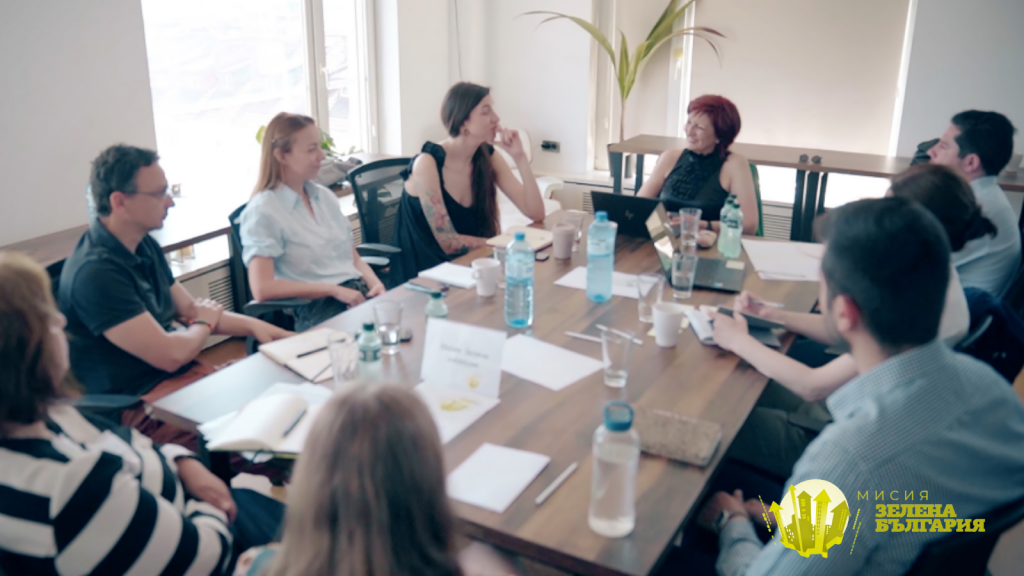
MOVE.BG-initiated Green Restart Coalition has brought together over 50 of Bulgaria's leading experts in the fields of innovation economy, energy transition, bioeconomy and biomass, smart cities, nature-based solutions and sustainable finance. In June, motivated by the desire to turn Bulgaria into one of the green and innovative leaders in Europe, they took part in a special event for generating sustainable development ideas "Mission Green Bulgaria".
During the event, over 150 challenges to Bulgaria's green transformation were outlined, as well as over 150 recommendations to overcome them. The Green Restart Coalition summarized the ideas in a special report containing six thematic chapters, based on the six groups into which the participants were divided:
- Mission Green Innovation
- Mission Energy Independence
- Mission Bioeconomy
- Mission Smart Cities
- Mission Nature-based Solutions
- Mission Sustainable Finance
Today, we present to you the challenges and recommendations, generated by the expert group Mission Green Innovation. Among the participants in the panel are:
- Sasha Bezuhanova, Founder of MOVE.BG, Member of the Investment Committee of the European Innovation Council, panel moderator
- Denimir Dimitrov, Founder of Zero Wave green startup, panel rapporteur
- Momchil Vassilev, Managing Director, Endeavor Bulgaria
- Vera Petkantchin, Chief Operating Officer, JA Bulgaria
- Janet Todorova, Head of Expansion at Founder Institute, Director at FI Eastern Europe
- Gergana Stancheva, Co-founder of LAM ON green startup
- Dobril Valchev, Senior Assistant Professor at the University of Architecture, Civil Engineering and Geodesy
- Maria Todorova, Director of Policies and Analyses Directorate, Ministry of Innovation and Growth
- Evgeny Kossev, Expert, ARS LTD
- Marin Marinov, Expert, MOVE.BG
Mission Green Innovation
Did you know?
Green innovation or eco-innovation is any form of innovation resulting in significant and demonstrable progress towards the goal of sustainable development, through reducing the impacts of human activity on the environment. This is stated in the Communication from the European Commission on the EU Eco-innovation Action Plan.
“Eco-innovation needs to be accelerated in a way that boosts resource productivity, efficiency, competitiveness and helps to safeguard the environment. More and more severe environmental challenges and resource constraints have led to growing worldwide demand for environmental technologies, products and services and have facilitated the emergence of green industries”, says the EC, and adds:
“Accelerated market uptake and dissemination of eco-innovation will lead to improved environmental performance and resilience across the economy being at the same time cost-effective and good for business and society as a whole.”
Greentech becomes an increasingly important part of eco-innovation as it employs new technologies to identify innovative solutions to key challenges relating to the climate crisis and the green transformation. Greentech projects use such technologies as big data, artificial intelligence, Internet of Things (IoT), and cloud computing, to mention just a few. Research estimates show that the global green technology market size will grow from USD 10.32 billion in 2020 to reach USD 74.64 billion by 2030.
Where are we?
Bulgaria continues to face substantial difficulties in the uptake of new technologies and the development of the innovative potential. It ranks 26th in the EU in terms of the integration of digital technologies in business and society according to the Digital Economy and Society Index (DESI 2021) of the European Commission and it scores last but one in terms of innovation performance in the Community according to the EC comparative analysis EU Innovation Scoreboard.
Bulgaria has the lowest score of the EU Eco-Innovation Index 2021 which measures the eco-innovation performance of businesses, society and the public administration, as well as its development and support on the level of research, business and government. The difficulties reported for Bulgaria are the weak and almost missing penetration of circular economy practices in production, the unreformed structure of the economy which needs urgent and rapid green transformation, and the low levels of state budget resources allocated for research and development (R&D) activities.
At the same time, according to the European Startups platform, there were over 750 small and medium-sized startups and more than 20 active VC investors as of July 2021. The data reveal that there is underinvestment in innovative businesses in the experimental phase and that most startups that have been supported are in the scale-up phase with tested and implemented innovative solutions. Thus, the important phase of innovation testing is left without private or public funding. A comparison to the best-developed startup ecosystem, that of Germany, shows that equity and venture capital investment by private funds is split in an almost 50:50 ratio between projects in the seed phase and the active phase. They build on a well-developed system of R&D centres and accelerators at universities.
However, the prevailing forms of investment in Bulgaria are still those in conventional technological solutions and SaaS platforms. Eco-innovative solutions account for a small share of investments and investors do not recognize them as a priority.
Challenges
Legislative and administrative challenges
- Lack of a legal definition of startup in Bulgaria: at present, innovative entrepreneurial projects are considered to be no different from ordinary small or medium-sized enterprises and the legislation does not take into account their specific features related to the testing of new technologies and the need for experimenting the ideas
- Lack of a certification system: no effective system is available to ensure green innovation labelling. At present, the only system used in the country is the EU Ecolabel system, but it reflects only the environmental effect of conventional businesses
- Lack of an effective national smart specialization strategy: the Innovation Strategy for Smart Specialization of the Republic of Bulgaria (2014-2020) has already expired and there is no analysis of what targets have been achieved or missed; there is lack of clarity about the adoption of a new strategy
- Delayed reforms to promote the transfer of scientific knowledge: the measures under the National Recovery and Resilience Plan (NRRP) in relation to the support for the commercialization of research projects are planned for post-2022 period, including the projects for establishing a network of research schools and an accelerator programme for innovative entrepreneurial projects at universities (spin-off projects)
- Lack of accessible experimentariums to test innovative ideas: the facilities with experimentation capabilities are either inaccessible to entrepreneurs or financially prohibitive for startup businesses
- Lack of regional strategies for the development of local innovative potential, including green innovation, in line with the regional needs, advantages and opportunities
- Lack of integration among industrial parks and innovation hubs that could turn them into centres for the development of a new type of economy at the regional level
- Still existing administrative burden: lack of digital business services
Financial challenges – access to capital
- Difficult access to funding for innovative green projects: lack of awareness of the importance of eco-innovation among investors
- Lack of a special focus on green innovation in the existing instruments of the Fund of Funds and the Bulgarian Development Bank
- Lack of conditions for funding the initial technological development phases of innovative projects (experimental phases and technology validation): weak interest by private investors (venture capital) and cumbersome and slow procedures of grant schemes;
- Problem with the image of Bulgaria Brand: the negative country connotations affect the interest of global funds in equity and venture investments
Challenges in applying for funding directly from EU structures (focus on the EIC)
- Bulgarian innovative startups face serious difficulties in applying for funding from the European Innovation Council (EIC). Few are the projects shortlisted for the final phase (face-to-face interview by a jury), while there is just a handful of those which have been approved for funding among all invited to participate
- Difficulties in the work with national and local structures: most structures are closed to companies in Bulgaria and thus they have no way to prove their concept in a real environment, which puts the EIC investment at risk
- Difficulties with the criteria for applicants: due to the lack of venture capital at the initial phase, it is difficult for the projects to submit results of a sound technology validation or well-developed professional and financial development models and market research for commercialization purposes, while both are of paramount importance for potential success with the EIC
- Difficulties in the preparation of the application: typically, startups are left on their own in the process of applying for funding, while developed countries have strong government structures which are instrumental in the preparation of the project proposals and in the preparation for the interviews
- Problem with the image of Bulgaria Brand: the negative country connotations affect the overall acceptance of Bulgarian projects
Education and information challenge
- Lack of green skills curricula in formal education, both in secondary and tertiary education
- Lack of awareness of the advantages resulting from the introduction of green innovation among conventional businesses that do not recognize the importance of the uptake of green innovation and its impact on competitiveness or the need for investment in the creation and development of green innovation
- Insufficient integration of Bulgaria in the networks of the European Institute of Innovation & Technology (EIT).
Solutions
Legislative and administrative solutions
- Introduction of a legal definition of startup, reflecting the specific features of startup businesses in their technological and business development
- Establishment of a national green innovation certification system to ensure that green innovation is recognized by investors and that measures are taken against greenwashing
- Development of a national smart specialization strategy by involving all stakeholders in the process, identifying specific steps for the implementation of the strategy, and introducing performance criteria and a continuous monitoring system
- Prioritization of the measures for the transfer of scientific knowledge and development of the innovative potential in the NRRP, including the establishment of a network of research universities with an accelerator programme for young entrepreneurs
- Establishment of experimentariums in various regions of the country (preferably on university campuses all over the country) to promote the development of the innovative potential at the regional level
- Reform of the existing laboratory facilities to open them to young entrepreneurs under affordable conditions
- Elaboration of a national green innovation development strategy to be worked out jointly by the government, local authorities, scientists, innovative startups, and conventional businesses. The strategy should highlight the challenges to the development of the innovative potential on the regional level and specific measures and steps to overcome them
- Integration of industrial parks and innovation hubs into specialized Industry 4.0 development centres. MOVE.BG proposed such a model in 2021
- Administrative reform by the digitalization of as wide range of business services as possible
- Simplification of the administrative procedures for the application and implementation of national and European scientific projects related to green innovations
- Introducing measures (financial, etc.) for support and promotion of Ph.D. students in the field of green technologies and the circular economy, as well as attracting them to scientific units (universities, Bulgarian Academy of Science’s institutes, innovation hubs, etc.)
- Selection of the most suitable green technologies (including nature-based ones) by experts and implementation of these tech solutions in an effective way according to the local characteristics of the country, the legislation and established traditions by sectors
Financial solutions – access to capital
- Implementation of awareness campaigns to recognize green innovation and promote it among Bulgarian and international investors
- Establishment of a Green Innovation Fund for target funding of projects in the initial phases of their development (pre-seed, seed)
- Development of programmes for public-private support of green innovation
- Development of programmes to support the business development of green innovation – accelerator programmes, business incubators providing mentorship and support to technology testing, preparation of marketing strategies and business plans
Solutions to facilitate the applying for funding directly from EU structures (focus on the EIC)
- Introduction of flexible schemes for national co-financing of projects at the initial stage of their development when they apply for funding from the EIC: provision of the funds needed for co-financing wholly or in part
- Specialized trainings for applicants for funding from the EIC: for instance, a regular EU masterclass in the form of an accelerator to be aligned to the deadlines for applications to prepare the projects for participation in the procedures with financial, marketing and legal experts acting as mentors
- Development of a model for cooperation between startups and the central and local government administration to facilitate the testing of green innovation
- Development of a marketplace-type platform for green innovation with the participation of entrepreneurs, VC investors, and scientists
Education and information solutions
- Introduction of green skills in formal education, both in secondary and tertiary education
- Implementation of awareness campaigns among conventional businesses to clarify the role of green innovation, the opportunities for its uptake by businesses, and its positive impact on the competitiveness of companies
- Full integration of Bulgaria in the programmes of the European Institute of Innovation & Technology.
The challenges outlined and the solutions generated are based on the shared ideas of the participants in the Mission Green Innovation panel. The ideas are summarized and grouped together without any claims that they have been approved unanimously by all participating experts in the panel.
Read the full “Missin Green Bulgaria”Report here (in English).
Read more about the Green Restart Coalition here (in English).