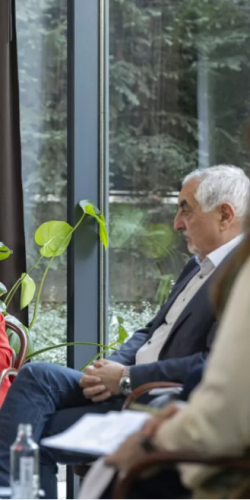
Climate change poses several challenges to our country that require immediate action and the development of a long-term and a clear strategy for a successful climate transition of the Bulgarian economy and society. Business representatives, scientists, and politicians, including the Deputy Caretaker Prime Minister Atanas Pekanov, have united around this. On September 28, they took part in a roundtable on Bulgaria's preparations for the UN International Climate Conference COP26 in Glasgow. The discussion was part of the conference "The Road to COP 26: The Choice of Bulgaria", which MOVE.BG organized together with the Embassies of the United Kingdom and Italy - the two countries that co-chair COP 26.
The Glasgow forum, which will take place between 31 October and 12 November, is the summit where commitments will be made for the first time under the new protocol to the United Nations Framework Convention on Climate Change (UNFCCC) - the Paris Agreement, which aims to limit global warming to 2 degrees by 2050 and aim to 1.5 degrees by the end of the century. According to several scientific studies, the increase in temperature will threaten living conditions on Earth and cause a number of crises, so urgent measures must be taken to reduce greenhouse gas emissions.
"In a month's time in Glasgow at the UN conference - also known as COP26 as this will be the 26th United Nations Climate Change Conference - countries are expected to have answers about the commitments they are making to save the planet from climate change, caused by human activities and industries. And before that the ball is in Italy - Milan, where the important PreCOP26 Summit will take place," said Irina Nedeva, moderator of the discussion, and Chairwoman of the Association of European Journalists-Bulgaria (AEJ).
Let's part with climate illusions
Each of the participants in the discussion shared what are the challenges facing Bulgaria in view of climate change and based on their professional experience and expertise.
"The main challenge for Bulgaria, perhaps, is to part with our climate illusions - that these are processes which do not concern us and that are happening in other countries. We have to be aware that these are inevitable processes in which we have to actively participate in order not to be left behind," said Mr. Pekanov, who is responsible for EU funds and the National Recovery and Resilience Plan, and explained his vision of what we should do:
"At the moment there is no long-term vision and it has to be developed as soon as possible.
For example, we can say an indicative date [for coal-exit] of 2035 - but what are we going to do until then. Not enough work has been done in Bulgaria over the years, and these decisions require deep analysis, expertise, scenarios for action.
In order to make the right decisions, not just about infrastructure projects that will, on the one hand, replace dirty energy production with cleaner energy production - we have set those out in the National Recovery and Sustainability Plan. But also reforms to help these processes develop.
As well as, on the other hand, something that I always emphasize, the compensatory measures that will give the people affected livelihood opportunities, will reduce socio-economic risks, and in the case of Bulgaria, these funds will come from the Just Transition Fund.
But all of this, the unlocking of these funds, depends on us making clear commitments that we too will go down this road. The first step is the public debate on this and the need to be aware of all these processes."
Boryana Kamenova, Director of the Climate Change Policy Directorate at the Ministry of Environment and Water, stressed the need for a debate as soon as possible and advocated for a comprehensive and integrated approach to the climate in all policies.
"For me, the main challenge in Bulgaria is the lack of national priorities and consensus. Without building consensus in society on a few key national priorities that need to be reflected in all national policies and channeling society's efforts to achieve them, we cannot achieve the ambitious goals we have set within the European Union.
Another major challenge is the integration of the climate issue into all policies. Unfortunately, in Bulgaria this is not yet the case - many of my colleagues in other departments do not recognize the climate issue and do not understand that it needs to be reflected in their policies.
The energy sector is clearly the challenge for Bulgaria. There are solutions developed globally and in Europe, and in the course of the debate we need to find the most successful and achievable ones for us, taking into account our national specificities.
Another major challenge is the transport sector, which, unfortunately, does not find much reflection in the public sphere and in political documents. But transport emissions are 18% and much higher than those from industry in Bulgaria."
According to Assoc. Prof. Kosyo Stoychev, lecturer at Sofia University "St. Kliment Ohridski", we need to clearly understand what science is telling us about climate and climate change, as well as to create mechanisms for a permanent dialogue between scientists, politicians, and business, so that important and correct decisions can be made.
"The Bulgarian state is in a very particular situation - our society has only recently noticed these problems. Twenty years ago we were just beginning to think about the profession of the ecologist, environmental norms, and environmental challenges - then the topic of climate was slowly emerging, which was the end result of the enormous efforts of very few scientists who had to convince first the other scientists that such a phenomenon existed.
No one is disputing natural climatic phenomena, it's just that there is one important condition - it has never happened with human civilization growing so expansively [in numbers].
20 years ago, a 1-degree increase in global temperature was considered absolutely impossible - today the ambitious target is 2 degrees, which means we will fly past 1 degree at 200 km/h and even the forecasts include larger deviations.
That is, the planet has been put into a cycle by the human civilization that is unknown to us, and that is a big risk. We don't know how much time we have to act."
Dimitar Enchev, a Managing Partner at the green investment fund PostScriptum Ventures, stressed the importance of adopting the European goals and acting to anticipate events - to plan longer term, which will make our economy more competitive.
"We need to stop talking about climate change, we need to start talking about a climate crisis or a climate catastrophe.
For Bulgaria the keyword, I think, should be ambition. Bulgaria has the challenge to decarbonize and this will not be easy because it represents a complete paradigm shift - the decarbonization of all human activity, of the economy. But it is also an opportunity for a lagging country to catch up.
So we need to approach this whole process with a bit more ambition, and if we look in detail, Bulgaria has a good starting position, for example in the energy sector. In the energy sector, we have good resources for renewable energy production, we have the Kozloduy nuclear power plant - carbon-free energy has already been built, we have 3 000 megawatts of hydropower plants, 1 000 of which are pump-storage - these are the batteries needed for an energy system so that it can integrate a large capacity of renewable energy sources.
So we have a super starting position and we need to show ambition to realize our potential."
Assoc. Prof. Hussein Yemendzhiev, lecturer at Burgas University and founder of the innovative start-up for smart water management ENOVA H2O, urged people to remember that the increase in temperature at the global level will affect each region depending on its characteristics. Water is one of the areas that will be most severely affected in the first stage of the climate crisis because rising temperatures will intensify natural cycles and water circulation.
"The climate crisis is the first planetary crisis that humanity will have to consciously manage. That is why the challenges and solutions are supranational.
Of course, our local context has its own specificities, and speaking about Bulgaria I see challenges in three main areas. The first is the adoption of new low-carbon energy sources. Secondly, we need to accelerate the process of the complete technological transformation of our economy towards circular practices.
And, of course, most importantly, society needs to begin to transform its consumption habits towards more sustainable practices and actions, so that these targeted actions in two different spheres of our lives can effectively help manage the climate crisis."
Watch the full recording of "The Road to COP 26: The Choice of Bulgaria" here (in the Bulgarian language).